Your Fractional Chief Automation Officer
Embedded in your leadership team to turn operational debt into EBITDA — without the $300k hire.
Our average audit uncovers $250k+ in annual savings in 2 weeks.
Free consultation. Let's discuss if the Fractional Automation Officer model is right for you.
Trusted by growing companies

Mid-market companies hire us at three inflection points.
Growth inflection
Series A–C, PE acquisition, scaling past $10M
Operational complexity
15+ SaaS tools, data silos, manual handoffs
Leadership gap
CEO/COO overwhelmed, no one owns the roadmap
Typical First-Year Results
30–40%
reduction in manual work
$250k+
in identified annual savings
15–25%
improvement in Revenue Per Employee
3–7
production automations deployed
Automation & AI Services for Mid-Market Operations
From first audit to full governance — we cover every stage of your automation journey.
AI Enablement Program
A complete 4–6 month automation transformation: Audit → Strategy → Build → Orchestrate → Govern → Train. Everything below, delivered under one program, one team, one fixed-term contract.
Includes AI Competency Frameworks embedded into your HR performance systems — so adoption is measured, not assumed.
Process Audit
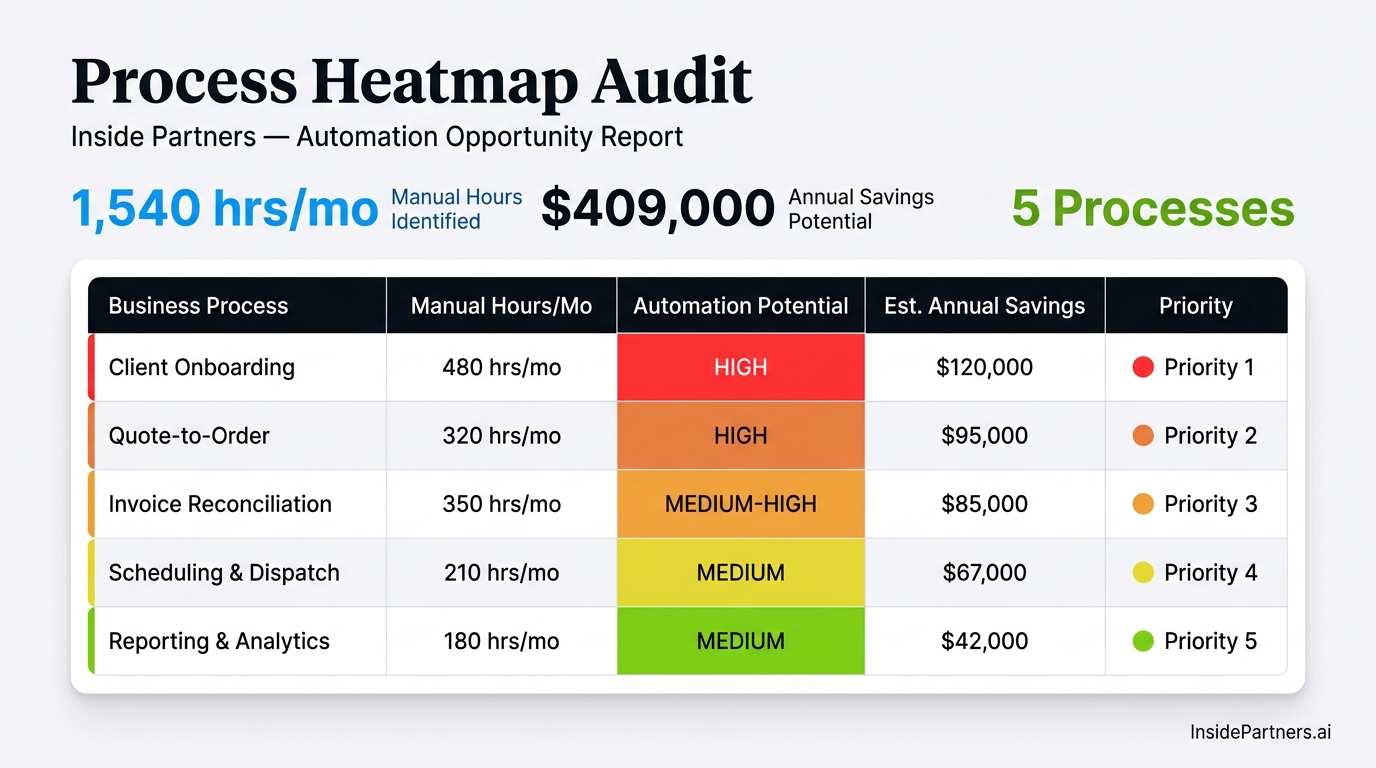
We map your workflows, identify automation opportunities, and deliver a board-ready Process Heatmap with projected ROI — in 2 weeks, fixed price.
Learn moreAutomation Strategy
A prioritized automation roadmap aligned to your revenue goals. We make the build vs. buy vs. ignore decisions so your team executes with confidence.
Learn moreProduction Automation
We build and deploy production-ready automations — connecting your CRM, ERP, WMS, and other systems to eliminate manual handoffs and data errors.
Learn moreIntelligent Workflow Orchestration
We connect your systems into intelligent workflows that coordinate across departments — routing data, handing off tasks, and executing multi-step processes without manual intervention. Think of it as autopilot for your operations.
Learn moreAutomation Governance
Ongoing fractional leadership. Your Fractional CAO (Fr-CAO) joins leadership meetings, approves tech stack decisions, manages your automation roadmap, and tracks Revenue Per Employee.
Learn moreTeam Enablement & Training
Upskill your team on AI tools, automation frameworks, and governance best practices — so your organization can sustain and scale what we build together.
Built for Operators Who Are Done Doing It Manually
Mid-market companies ($5M–$100M) where margins matter and the ops leader is carrying too much.
Logistics & 3PLs
Still running fulfillment, billing, and client reporting on spreadsheets? We connect your WMS, TMS, and CRM so your team stops being the integration layer.
See how it worksResidential Property Management
Managing 200+ units shouldn't mean 200+ manual tasks. We automate tenant screening, maintenance routing, rent collection, and owner reporting end to end.
See how it worksLegal Firms
Every hour spent on intake paperwork, billing reconciliation, and document routing is an hour not billing. We eliminate the friction between your attorneys and your revenue.
See how it worksPlace Managers (BID/GID)
Coordinating dozens of stakeholders, events, and city agencies shouldn't live in your inbox. We automate the communications and reporting that keep your district running.
See how it worksHealthcare & Medical Practices
Automate patient intake, insurance verification, billing, and claims so providers focus on care.
See how it worksProfessional Services
Automate time tracking, project delivery, billing, and client intake for consultancies and agencies.
See how it worksSaaS & PE Portfolio Companies
Automate lead-to-cash, renewals, and investor reporting to demonstrate scalable operations.
See how it worksManufacturing
Connect ERP, MES, and shop floor data to automate scheduling, quality, and inventory workflows.
See how it worksAccountants & Bookkeeping
Automate client onboarding, month-end close, and advisory workflows to serve more clients without adding staff.
See how it worksWealth Management & Financial Advisors
Streamline onboarding, ACATs, review prep, and compliance so advisors spend more time with clients.
See how it worksReal Estate Brokerages
Automate lead distribution, transaction coordination, agent onboarding, and commission processing.
See how it worksEnergy & Production
Connect field operations, asset tracking, and compliance reporting into one automated pipeline.
See how it worksEducation
Automate enrollment, financial aid processing, course scheduling, and compliance reporting.
See how it worksNon-Profit & NGO
Automate donor management, grant reporting, and volunteer coordination to maximize mission impact.
See how it worksGovernment
Modernize citizen services with workflow automation for permits, records, and inter-agency coordination.
See how it worksOur 3-Step Process: Audit, Pilot, and Governance
The audit alone changed how we think about ops. We had no idea how much time was bleeding into manual processes. The roadmap they delivered was immediately actionable.
Chris V.
Founder, One Step After
We thought we had an automation agency problem. We actually had a governance problem. Inside Partners forced us to prioritize and own automation the way we own finance and sales.
Mark N.
Founder, StartTalking
You've invested in tools. Your team is still doing it manually.
SaaS sprawl, data silos, disconnected systems — the tools are there but no one owns making them work together. That gap is Operational Debt. And it compounds.
The usual options
Full-Time CTO / CAO
$300k+/year. Product-focused. 3–6 months to hire. Wrong hire = 12-month sunk cost.
Automation Freelancers
Build tasks, not strategy. No governance. Gone when the project ends.
Consultants
Deliver slide decks. Recommend tools. Don't execute or maintain.
The better model
Fractional Automation Officer
$60k+
starting at $5k/month — cancel anytime
✓ Embedded in your leadership team
✓ Start in 2 weeks
✓ First audit typically finds $250k+ in savings
✓ 73% of PE-backed mid-market companies use fractional execs
94%
Faster billing
3 days → 4 hours · Logistics company
420 hrs
Eliminated per month
Manual work removed · Teletherapy platform
59%
Faster decisions
6 weeks → 10 days · District organization
Partner, not vendor. Outcomes, not workflows.
We sit at the leadership table and own the P&L impact — not just the ticket queue.
| Automation Agency | Inside Partners | |
|---|---|---|
| You talk to | A project manager | A C-suite executive |
| They focus on | Isolated workflows | Operational efficiency & Revenue Per Employee |
| Billed | Hourly / project | Leadership retainer |
| You end up with | 5 minutes saved on one task | Improved EBITDA, higher valuation, and a proprietary automation stack you own |
| Compliance | Not their problem | SB 26-189–ready governance included |
Who Hires a Fractional Automation Officer?
The leaders who bring us in share one thing: they know automation matters, but no one on the team owns it.
CEO / Founder
Knows the company needs automation leadership but can't justify a $300k+ full-time hire. Wants board-ready metrics and EBITDA impact.
COO / VP Ops
Carrying the operational load across too many systems. Needs someone to own the automation roadmap and stop the firefighting.
PE Operating Partner
Needs to demonstrate operational efficiency gains across portfolio companies. Wants a scalable automation model, not one-off fixes.
CFO
Sees the SaaS sprawl on the P&L. Wants to understand which tools are earning their keep and where manual work is leaking margin.
CTO / VP Engineering
Focused on product. Needs someone to own internal operations automation so the engineering team can stay on product roadmap.
VP People / CHRO
Building AI competency frameworks and proficiency rubrics so HR can measure and manage AI adoption through existing performance review cycles.
Not for everyone — and that's intentional.
We only work with companies where we can drive real outcomes. If any of these sound like you, we're probably not the right fit.
Pre-product-market fit startups
Nail what you're building first.
Teams wanting one-off automations
We're executives, not freelancers.
Organizations resistant to change
Automation requires process discipline.
We Wrote the Book on This
The Automation Officer Handbook is used by founders, operators, and PE firms to evaluate and design automation programs — from first audit to ongoing governance.
"The clearest framework I've seen for making automation a leadership function, not a side project."
Efficiency + Compliance
Colorado repealed its original AI Act and replaced it with SB 26-189, effective January 1, 2027. The new law shifts from discrimination-prevention to disclosure and human-review obligations for automated decision-making — including tenant screening, hiring, and other consequential decisions. Our Process Heatmap Audit now maps every automated tool touching a consequential decision and wires in the notice and human-review workflows the new law requires — so compliance lives in your operations, not a binder.
Frequently Asked Questions
Do we need an internal tech team to work with you?
No. We plug into whatever you have — internal engineers, an existing agency, or no technical team at all. We lead the roadmap and governance regardless.
What's the typical engagement length?
Most engagements run 6–18 months. The first 90 days focus on the audit, quick wins, and building the initial automation portfolio.
What tools and platforms do you work with?
Salesforce, HubSpot, NetSuite, WMS/TMS, accounting platforms, and modern automation stacks (iPaaS, RPA, custom code). We are vendor-agnostic and optimize for your context. Learn about BPA, RPA, IPA, and other approaches →
We already have an automation agency. Can you work alongside them?
Yes — this is common. We come in as the strategic layer: governing the roadmap, prioritizing the backlog, and ensuring your agency is building toward your actual business goals, not just closing tickets.
What about data security, confidentiality, and IP ownership?
Every engagement begins with a mutual NDA. All automations, code, and documentation we produce are fully transferred to you — we retain no ownership, no licenses, and no back-door access. You own the code, the workflows, and the IP. Your data never leaves your systems without explicit written approval. We operate under strict confidentiality obligations and are happy to review or adapt our standard agreements to match your legal requirements.
How do you ensure our team actually adopts AI tools?
We build it into your performance infrastructure. Our AI Enablement Program creates a role-specific AI Competency Framework — a measurable rubric that defines what AI proficiency looks like at every level of your organization. We then work with your HR team to automate that rubric into your existing performance management systems, so every manager has clear criteria and talking points for review cycles. The result: AI adoption isn't optional or aspirational — it's measured, managed, and tied to professional development. Companies like Meta are already formally evaluating employees on AI impact. We help you get there before your competitors do.
Start With the Truth
We don't guess. We audit. Our benchmark: uncover at least $250k in annual savings in your first 2 weeks — or you'll know exactly why not.
In your free consultation, we'll:
- Map 3–5 suspected operational debt hotspots in your business
- Estimate savings potential and automation feasibility
- Decide together whether the Process Heatmap Audit is right for your stage
No pitch deck. No pressure. Just a direct conversation about what's costing you money.