Ban it or ignore it — most companies pick one, and both backfire.
Right now, most companies' entire AI strategy is one of two things: “don't use it,” or a nervous shrug. Neither holds up. Your team is already using AI — banning it just pushes it onto personal phones and logins where you have zero visibility, and saying nothing leaves everyone guessing where the line is. The fix isn't a 30-page policy nobody reads. It's one page of ground rules people can actually follow.
What's encouraged.
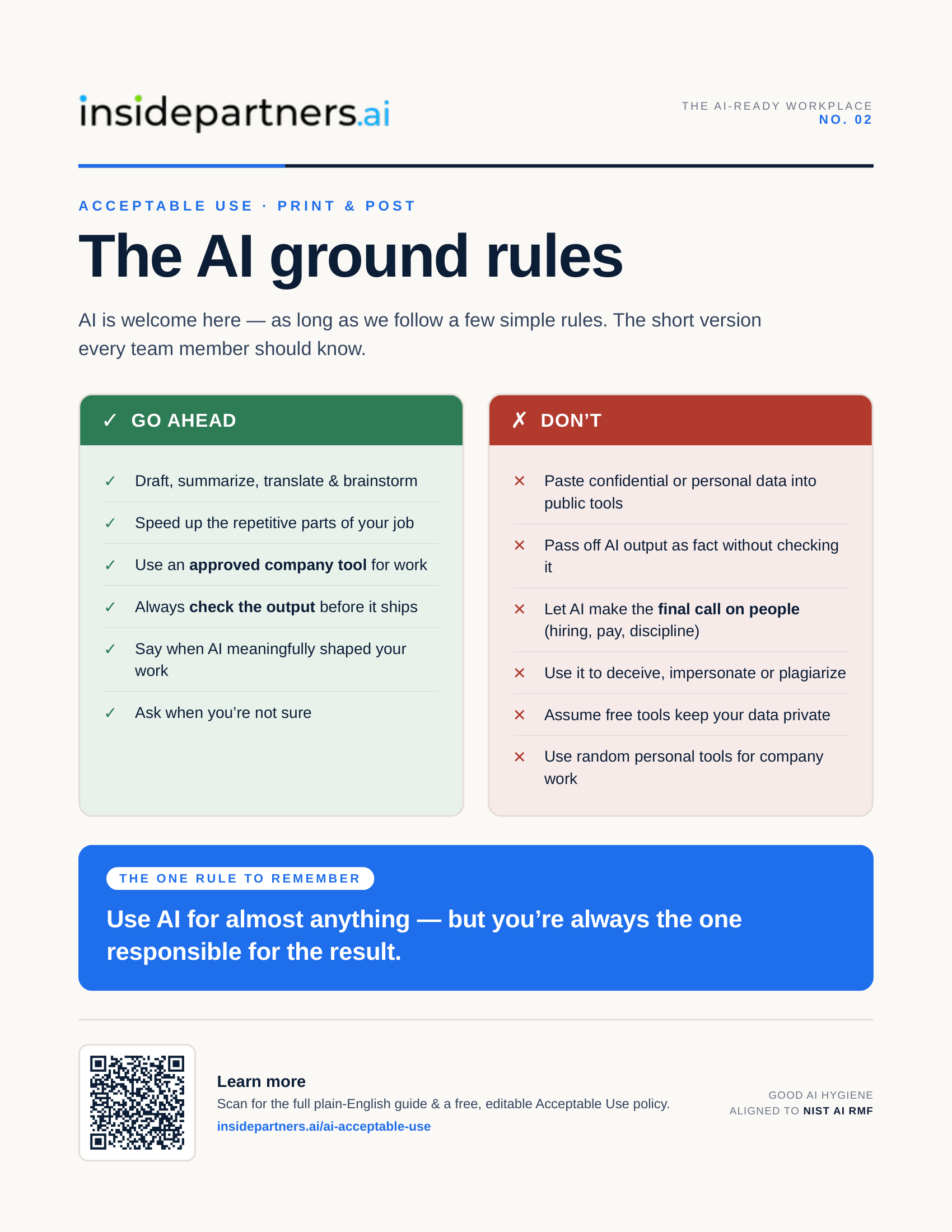
Be clear that AI is welcome for the everyday work it's genuinely good at: drafting, summarizing, translating, editing, and brainstorming; speeding up the repetitive, time-consuming parts of a job; and research or getting unstuck — as a starting point you then verify. The one condition: for anything work-related, use an approved company tool, not a random personal account.
What's not allowed.
Draw a few bright lines everyone can remember. Don't paste confidential or personal data into public AI tools (that's covered in detail in Week 1). Don't pass off AI output as fact without checking it. Don't let AI make the final call on decisions about people — hiring, pay, discipline — without meaningful human review. Don't use it to deceive, impersonate, or plagiarize. And don't assume “free” tools keep your data private; many train on whatever you type.
The one rule that covers most of it.
If your team remembers nothing else, make it this: you can use AI for almost anything — but you're always the one responsible for the result. AI is a tool, not a decision-maker. Whatever you send, publish, or act on is yours. That single principle resolves most day-to-day judgment calls on its own.
Make it stick.
Print the poster and put it where people work. Adopt the one-page Acceptable Use policy so the expectation is written down, not assumed — it takes about ten minutes to customize the highlighted fields. Both are free below, no email required. (As AI disclosure and transparency rules take shape — for example, Colorado's SB 26-189, effective January 2027 — having a written, adopted AI policy is a sensible first step; adapt it with your counsel.)